Why does a long coat change how the legs read?
A vertical proportion reading: three reference stops and one decisive endpoint.
This analysis is saved on this device
01 — See the whole look
Begin with the image as it is. When you are ready, explore what Basira reads in it.
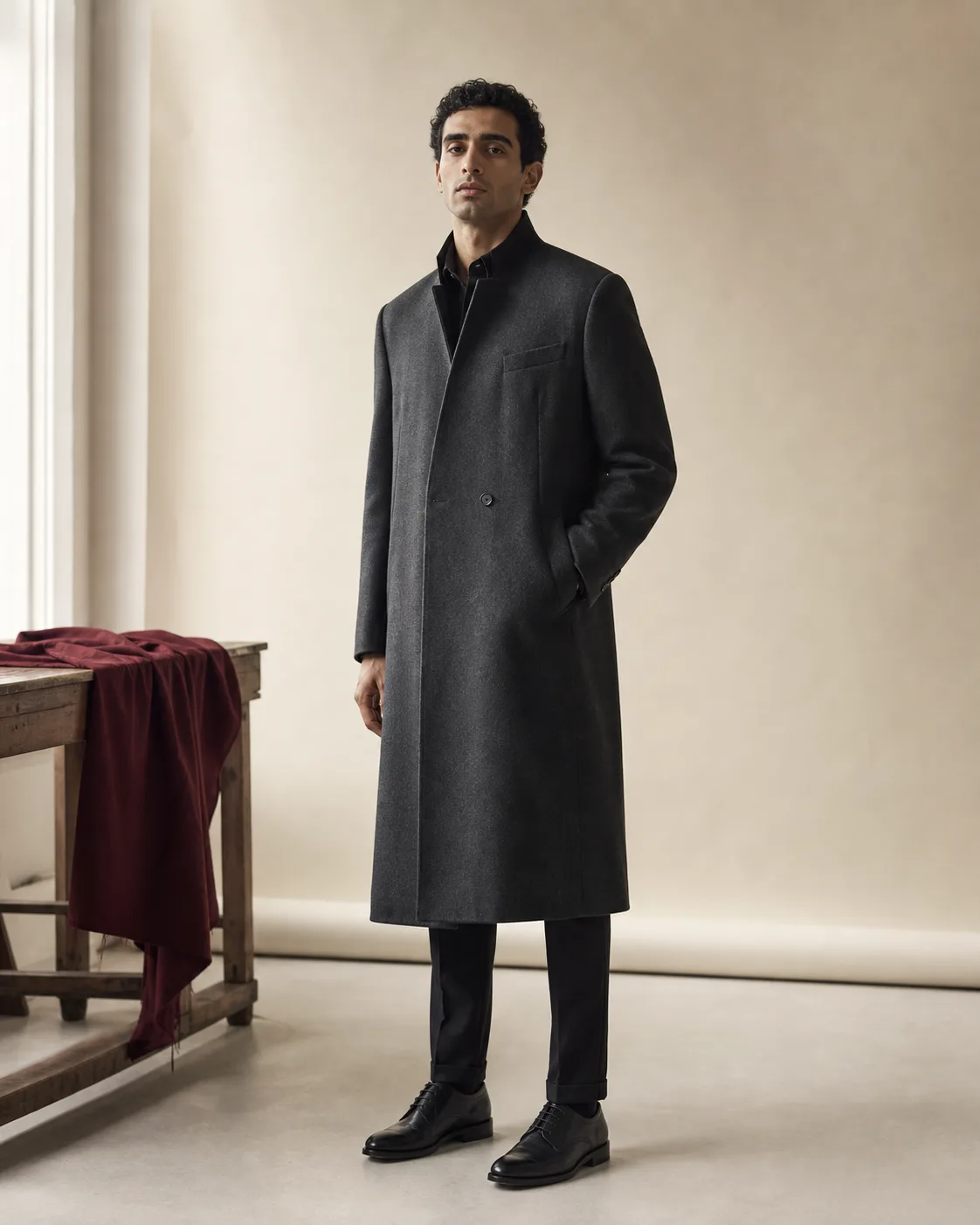
Desire before analysis
Notice the overall line, volume, and rhythm before choosing what to inspect.
Now look at the whole look again — what does your eye notice that it didn't before?
Full text version of this analysis
Proportion
Three vertical stops that reveal how leg length is read.
- 1. Shoulder line: where measuring starts — The reference extension starts at the shoulder edge. Notice that shoulder-to-first-button is short relative to the whole figure; this compressed upper segment is what makes everything beneath read longer.
- 2. Coat hem sits below the hip — The coat ends just past the hip, near mid-thigh rather than at the hip bone. When this endpoint moves lower, the distance the eye reads as “leg” begins further down — so the leg appears extended.
- 3. Knee level: an unbroken stretch — An imagined rule at the knee. Between the coat hem and this line runs a clear, uninterrupted stretch; that continuous span — not the trouser length itself — creates the sense of long legs.
Silhouette
The outer boundary of the look before any internal detail.
- 1. Outer container: a quiet column — From shoulder to hem the outer side descends nearly straight with a slight flare. The extracted overall shape is an elongated vertical rectangle — the source of the look’s stillness.
Color
What closely matched darks do — and what one accent does.
- 1. Matched darks extend the line — Coat and trousers sit close in depth and temperature. With no color break at mid-body, the vertical impression continues without stopping. A strongly contrasting trouser would visually split the figure at the hem.
- 2. One point of color — The deep oxblood touch at the neck gathers the top of the look into a single point and keeps it from dissolving. One color point near the face is usually enough; more scatters attention.