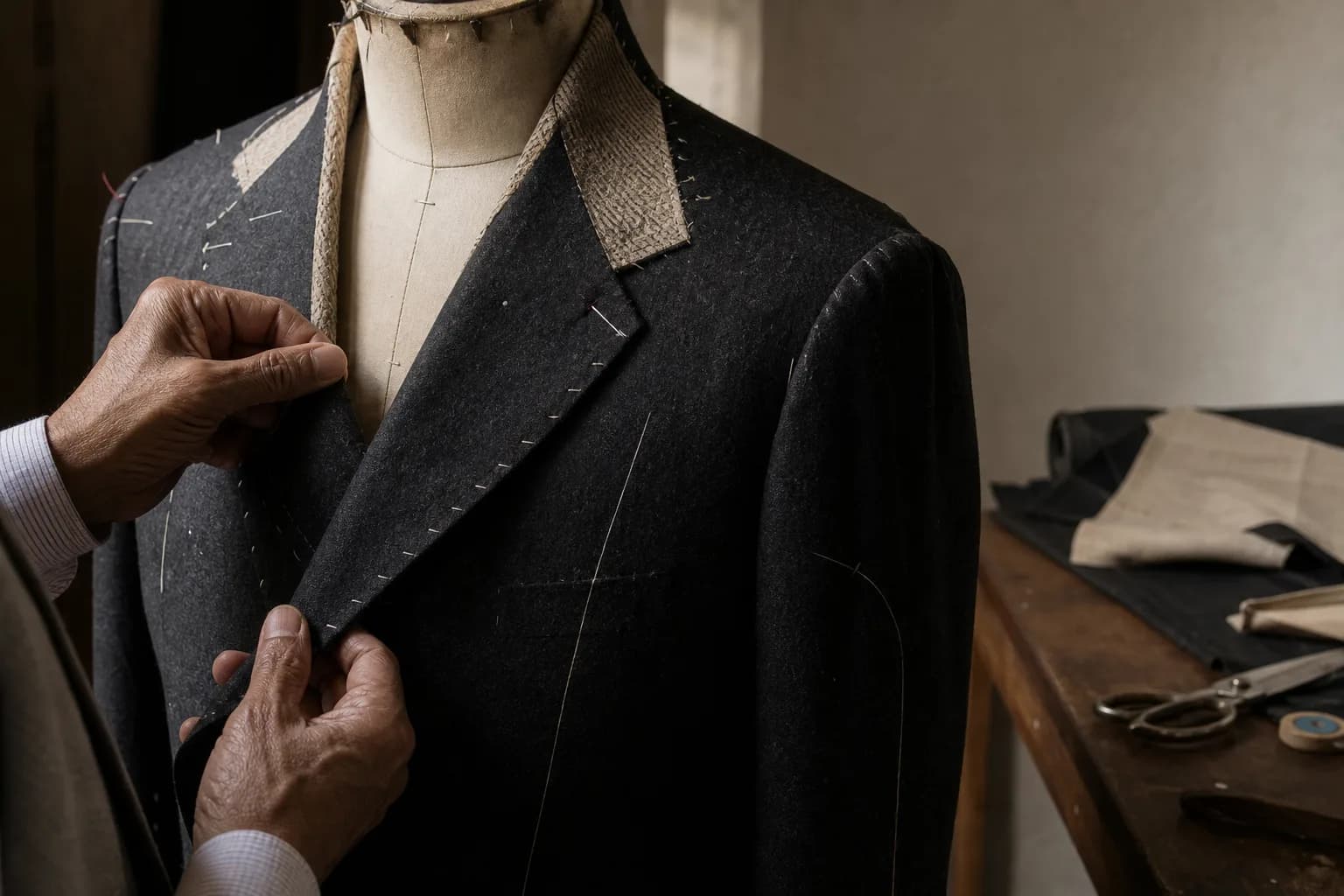
We say a jacket “sits well” as though sitting were a mysterious quality. It is the visible result of three relationships: where the real shoulder ends, how the line slopes toward it, and how the sleeve head rises beneath it.
1 — See the slope
A near-horizontal shoulder gives a jacket architectural presence. More slope softens the edge. A كتف طبيعي is not unstructured; its structure simply declines to announce itself.
The evidence is not padding alone, but the transition from neck to sleeve without an abrupt break.
2 — Trace the join
Where the sleeve head meets the armhole, a deliberate ridge may create a roped shoulder. Neapolitan construction may instead ease excess cloth into tiny folds. Both are decisions, not automatic defects.
3 — Return to distance
After tracing the detail, step back. Does the line lead the eye to the face, widen the body, or descend quietly? A useful interpretation always returns to the whole silhouette.